
Walk into any coaching institute today and you'll notice the same pattern. A WhatsApp group with three hundred students where important notices get buried under good morning messages. A Google Drive folder full of PDFs that nobody can find when they need them. A register full of names and phone numbers for fee collection, updated by hand. This is how most coaching institutes, tuition centers, and training academies in India still operate in 2026, even as the students they teach carry smartphones more powerful than the computers used to send astronauts to the moon.
The gap between how students consume information in every other part of their life and how they receive their study material is getting wider every year. They order food through an app. They book cabs through an app. They watch lectures on YouTube and take notes on Notion. But when it comes to their most important academic investment, the coaching institute that is preparing them for an exam that could define their career, they are handed a photocopy and added to a WhatsApp broadcast list.
This article is about the shift happening right now, quietly, across coaching institutes that are choosing to build their own dedicated app instead of continuing to rely on scattered tools. If you run a coaching institute, an academy, a tuition center, or an exam-preparation business of any kind, this is worth fifteen minutes of your time.
The Problem With WhatsApp Groups and PDFs
WhatsApp is free, familiar, and easy to set up, which is exactly why almost every institute starts there. But free tools come with hidden costs that show up over time.
First, there is no structure. A student who joins in March has no easy way to find the notes that were shared in January. Everything disappears into scroll history within days.
Second, there is no way to sell anything properly. Institutes end up collecting fees in cash or through personal UPI IDs, keeping track of who has paid and who hasn't in a notebook or a spreadsheet, and manually adding or removing students from groups when their course validity ends.
Third, there is no branding. A WhatsApp group with your institute's name does very little to build a professional identity. Parents and students today associate legitimacy with a polished digital presence, the same way they trust a shop more when it has a proper signboard instead of a hand-painted one.
Fourth, and most importantly, there is no way to track engagement. You have no idea how many students actually opened the notes you shared, how many attempted the mock test, or how many are falling behind. You are running a business blind.
An institute app solves all four of these problems at once, and it does so in a way that is now genuinely affordable for even small and mid-sized coaching centers.
What a Modern Course-Selling Institute App Actually Looks Like
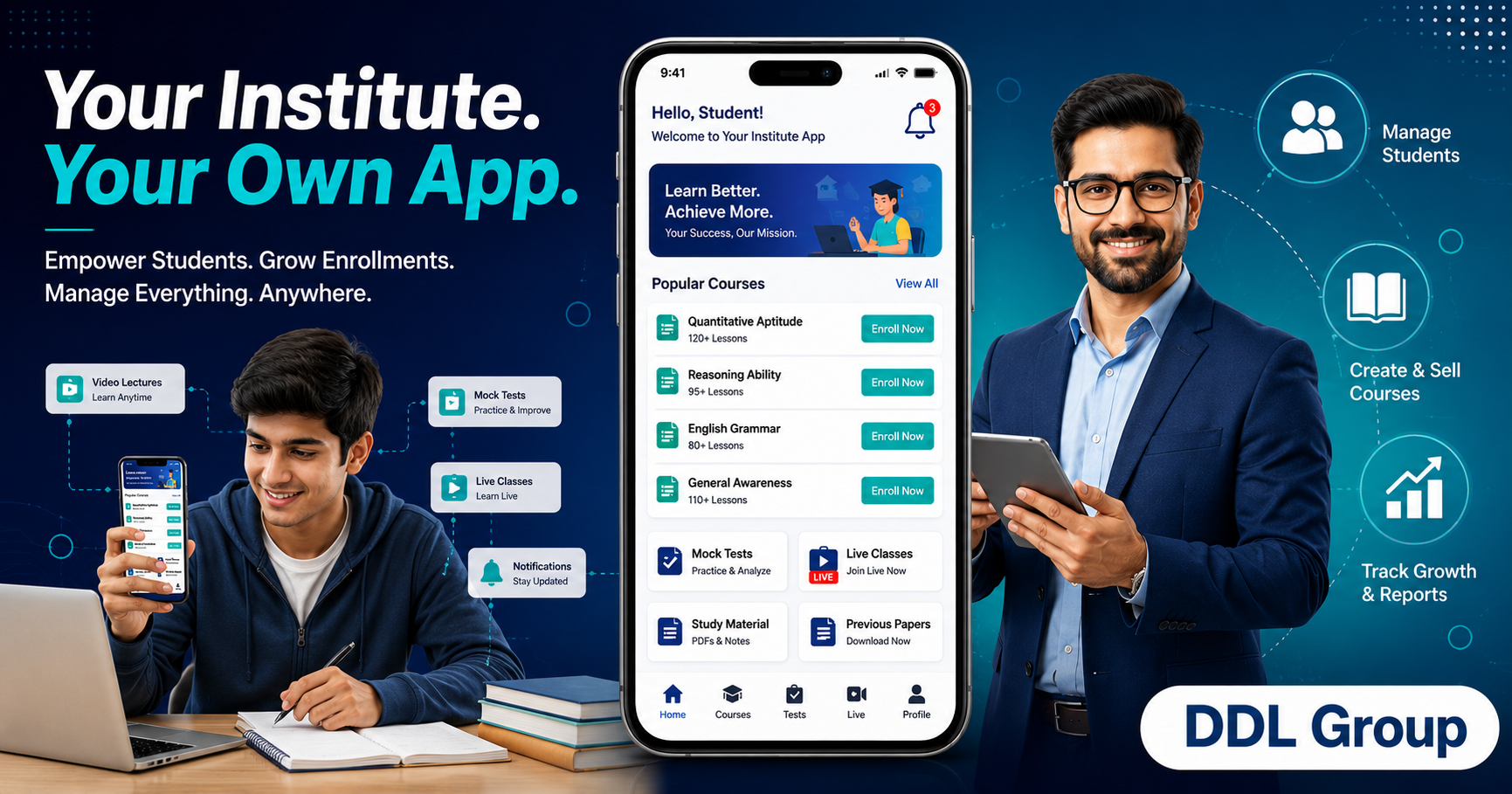
The idea of "building an app" used to sound expensive and technical, reserved for large edtech companies with venture funding. That is no longer true. A modern institute app can be built quickly, affordably, and specifically around how coaching businesses actually operate. Here is what such an app typically includes.
Daily Study Notes
Instead of PDFs scattered across WhatsApp forwards, students get a dedicated section inside the app where new notes are added daily, organized by subject or topic. Nothing gets lost. Nothing needs to be searched for in old chat history. A student preparing at eleven at night can simply open the app and find exactly what was taught that day.
Daily Capsule and Mock Test
Consistent daily practice is what separates students who clear competitive exams from those who don't. A built-in daily capsule, a short, focused revision set, paired with a daily mock test, keeps students engaged every single day rather than only before the exam. This also gives the institute a natural reason for students to open the app daily, which builds a habit loop similar to how social media apps keep users coming back.
Regular Study Material Updates
Exam patterns change. Syllabuses get revised. New questions from recent exams need to be added. An app-based system means updates go out instantly to every enrolled student the moment new material is ready, without needing to re-share files individually or repost in a crowded group.
Unlimited Mock Tests
Practice is the single most requested feature by serious exam aspirants. An unlimited mock test library, with results and performance tracking built in, gives students the ability to test themselves as many times as they want, at their own pace, and see exactly where they are improving.
Recorded Classes
For students who miss a live session, or who simply learn better by rewatching a concept twice, recorded classes turn a one-time live class into a permanent learning resource. This single feature dramatically increases the perceived value of a course, because students are no longer paying only for one hour of live teaching, they are paying for a resource they can return to anytime.
Live Classes
Live sessions remain the emotional core of any coaching institute. They create real-time interaction, doubt clearing, and a sense of accountability. An app that supports live class scheduling, with automatic push notifications reminding students when a class is about to start, ensures attendance stays high.
Why This Matters More Than It Seems
It's easy to look at this feature list and think of it as simply digitizing what already exists. But the real value is in what changes once these features exist inside a proper app rather than being scattered across WhatsApp and Google Drive.
For the institute owner, it means being able to actually sell a course. A course inside an app can have a clear price, a defined validity period like one year, and an enrollment process that is instant and trackable. This turns a coaching institute from a local, word-of-mouth business into something closer to a subscription product, with predictable revenue and the ability to enroll students from outside the immediate neighborhood, since an app has no geographic boundary.
For the student, it means a dramatically better learning experience. Everything lives in one place. Notifications keep them on track without needing to be added to five different groups. Progress feels visible because mock test scores and completed material are tracked automatically.
For parents, an app-based institute simply looks more credible. In a market where trust is often the deciding factor in which institute a family chooses, having a professional app puts a coaching center in a different league compared to competitors still running everything through phone calls and paper receipts.
The Technology Behind It, Explained Simply
A common assumption is that building an app means going through the Google Play Store approval process, paying developer fees, and waiting weeks for updates to be approved. This used to be true, but it isn't anymore, thanks to a technology called a Progressive Web App, or PWA.
A PWA is essentially a website that behaves like a native app. Students can install it directly to their phone's home screen with a single tap, no Play Store download required. Once installed, it opens exactly like any other app, works even on slow or intermittent internet connections, and can send push notifications the same way a native app does.
The advantages of this approach for a coaching institute are significant. There is no waiting period for app store approval when you want to update content or fix something. There are no Play Store commission fees eating into course revenue. The app is lightweight, which matters enormously for students in smaller towns where storage space and data speed are real constraints. And updates go live instantly, the moment they are published, rather than needing a new version submitted for review.
This is precisely the kind of technology stack that makes it realistic for a coaching institute, even a relatively small one, to have its own branded app without the cost or complexity that used to make this option available only to large companies.
How the Process Actually Works
For an institute owner considering this step, the process is far simpler than most expect. It generally involves an initial discussion to understand what courses, subjects, and content the institute wants to feature, followed by designing the app's branding around the institute's name, logo, and colors so it feels entirely native to the business rather than generic. Content such as notes, test series, and class schedules is then structured inside the admin panel, giving the institute owner or their staff full control to add and update material without needing any technical knowledge. The app is tested and launched, after which it is ready to be installed by students directly from a shared link, with no app store submission required.
Most institutes can go from initial conversation to a live, working app within a matter of days, not months.
Addressing the Common Hesitations
Three questions come up almost every time this topic is raised with institute owners, and they're worth addressing directly.
The first is cost. Many owners assume an app costs lakhs of rupees to build. In reality, with the PWA approach described above, a fully functional course-selling institute app can be built starting under ten thousand rupees, a fraction of what native app development used to cost, and well within reach for coaching centers of almost any size.
The second is technical complexity. Owners worry they will need to hire a developer permanently to manage the app. This isn't the case. A well-built admin panel is designed for non-technical users, meaning adding a new note, uploading a mock test, or scheduling a live class takes the same effort as posting in a WhatsApp group, just organized properly.
The third is whether students will actually use it. This concern usually disappears quickly once the app is live, because the installation process is simple, the app is genuinely faster and less cluttered than scrolling through group chats, and students, being digital natives, generally prefer a dedicated app over a messy chat interface the moment they experience the difference.
Where This Is Heading
Education in India is moving unmistakably toward hybrid and app-based delivery, and this shift isn't limited to large edtech companies anymore. Local coaching institutes, tuition centers, and regional academies are increasingly building their own digital identity, and the ones who move first tend to gain a lasting advantage in their local market, simply because they become the modern option in an area where most competitors are still operating the old way.
For an institute owner, the question is no longer whether to make this shift, but when. Every month spent managing students through scattered WhatsApp groups is a month of lost data, lost professionalism, and lost opportunity to convert that audience into a properly structured, paying course base.
A Quick Comparison: Old Way vs App-Based Way
It helps to see the difference laid out plainly. In the old way, a new student joining mid-term has to be manually added to a WhatsApp group, then scroll back through weeks of messages hoping to find notes that were shared earlier, often giving up and asking a classmate instead. In the app-based way, that same student installs the app, logs in, and immediately sees every note, test, and recorded class organized by date and subject, available from day one.
In the old way, fee collection means chasing parents for UPI screenshots, writing entries in a register, and hoping nothing gets missed when validity periods end. In the app-based way, enrollment, payment, and validity are all handled inside the system, with the institute owner able to see at a glance who has paid, who is enrolled, and when access is due to expire.
In the old way, a mock test means printing papers or sharing a PDF and manually checking answers, which limits how often tests can realistically be conducted. In the app-based way, students can attempt unlimited mock tests on their own schedule, with results generated instantly, freeing up the teaching staff to focus on actually teaching rather than checking papers.
This comparison is not about technology for its own sake. It is about time saved, revenue protected, and a level of professionalism that directly affects how many new students choose your institute over the one down the street.
Getting Started
If you run a coaching institute and you're ready to move beyond WhatsApp groups and scattered PDFs, building your own branded course-selling app is more accessible than you might think. Digital Design Leadership Group, DDL Group, has been building digital solutions for institutes, schools, and businesses since 2017, and can help you launch your own app with the exact structure described in this article, daily notes, mock tests, live and recorded classes, and instant push notifications, fully branded to your institute.
To discuss building your institute's own app, reach out directly.
Phone or WhatsApp: 7551067843
Email: [email protected]
Website: ddlg.in